
Lately I've heard a few friends say they haven't really found a use for AI. I'd been using it for work, but I still kind of got where they were coming from — until a few months ago, when something shifted for me, and I think it comes down to the tool. I want to talk through some of the ways I've used it since.
If your only experience with AI is a chat window in a browser, you're basically using it as an enhanced search engine. You ask a question, you get an answer, you copy the answer somewhere else. That's genuinely useful, but it isn't far off from a better Google.
Everything changed for me when I started using Claude Code connected directly to my computer. Not a chat window — something with access to my actual files, my folders, my photos. It stopped answering questions and started doing work. Let me walk you through what I mean, because it started with something small.
My nephew Cade leaves for a mission trip to Hiroshima, Japan in about a week. Right around the time I found that out, I was cleaning my office and came across my own journal from a mission trip to Kenya in 2009. Just for kicks, I took a photo of one page to see whether Claude could transcribe my chicken scratch. It did very well. So I photographed the rest.
Twenty-nine pages, transcribed in about fifteen minutes, tops. There were little inconsistencies — my spelling, my handwriting, a few words it had to guess at — but no more than another person trying to read my handwriting would have made, and I went back through and fixed those myself.
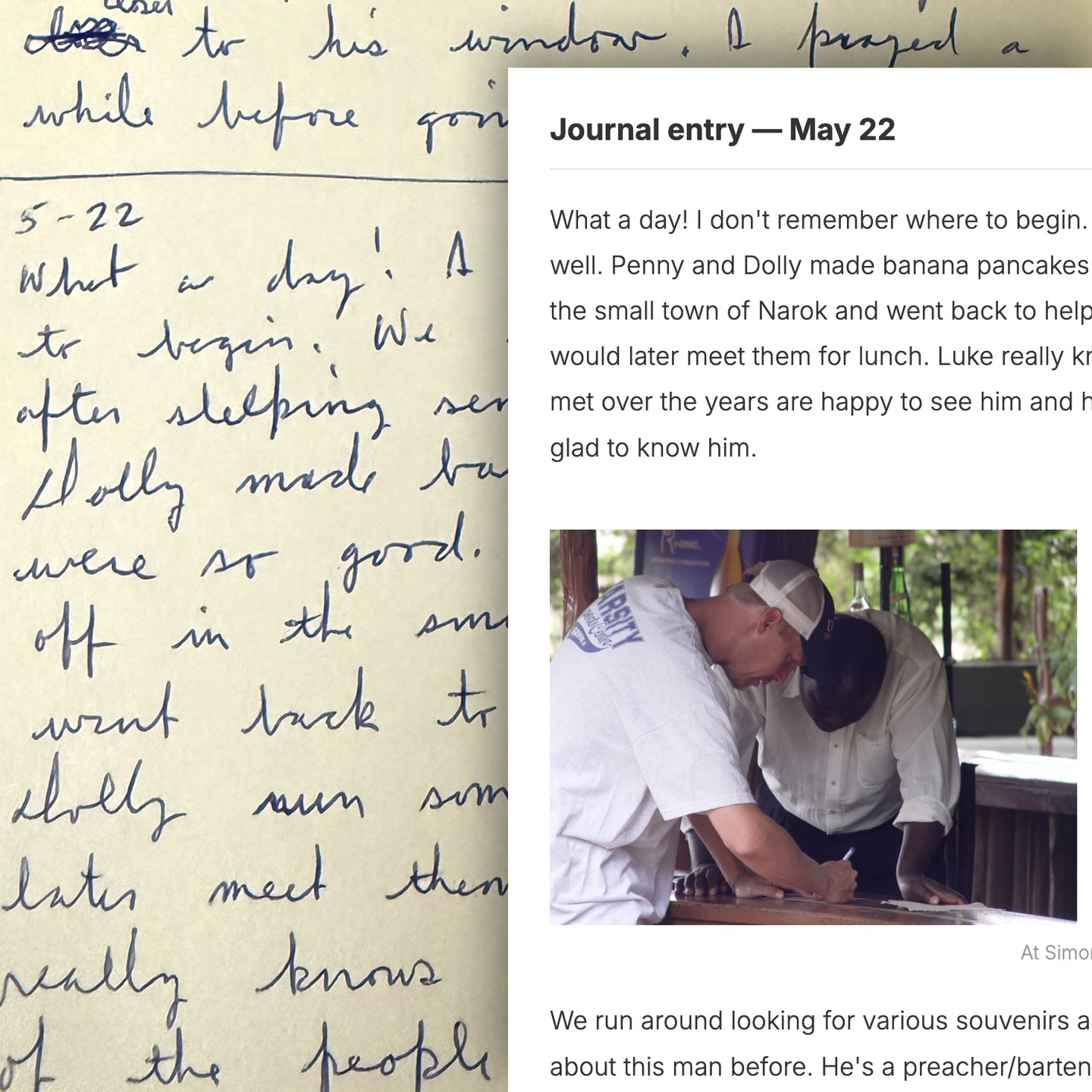
Typing out 29 handwritten pages always seemed too daunting. I actually started right when I got back in 2009, got a little way in, and then just put it up. That hurdle is the whole reason nothing ever came of it, and the journal sat in a box for all these years. But once the text existed, I finally felt like I could put something together for Cade to read before he goes. That's what this turned into: my whole journal from the trip, start to finish, exactly the way I wrote it back then. I didn't go back and clean up the writing or fix how 2009 me put things — whatever I scribbled down at the end of each day is what's there.
That was the first thing. The second was the photos, and this one turned into a bit of a mess. I had multiple sets scattered across folders on my computer, taken by different people on different cameras, with different timestamps. Mine were on a Sony. Luke's were on a Canon. Somewhere in there were around 1,300 image files, and I needed to know what was taken when so I could place each one in the right day of the journal.
The trouble was the two cameras disagreed with each other. It turned out mine was set twelve hours off — which makes a certain amount of sense when you're halfway around the world. The fix was a single twelve-hour shift, but the part I appreciated was that it didn't just assume. It checked. There was a museum both Luke and I had photographed, and the corrected times lined our two cameras up on it. Then it checked the correction against the whole trip and the days fell into place. It also turned up about 200 duplicate copies of photos I'd scattered across subfolders over the years.
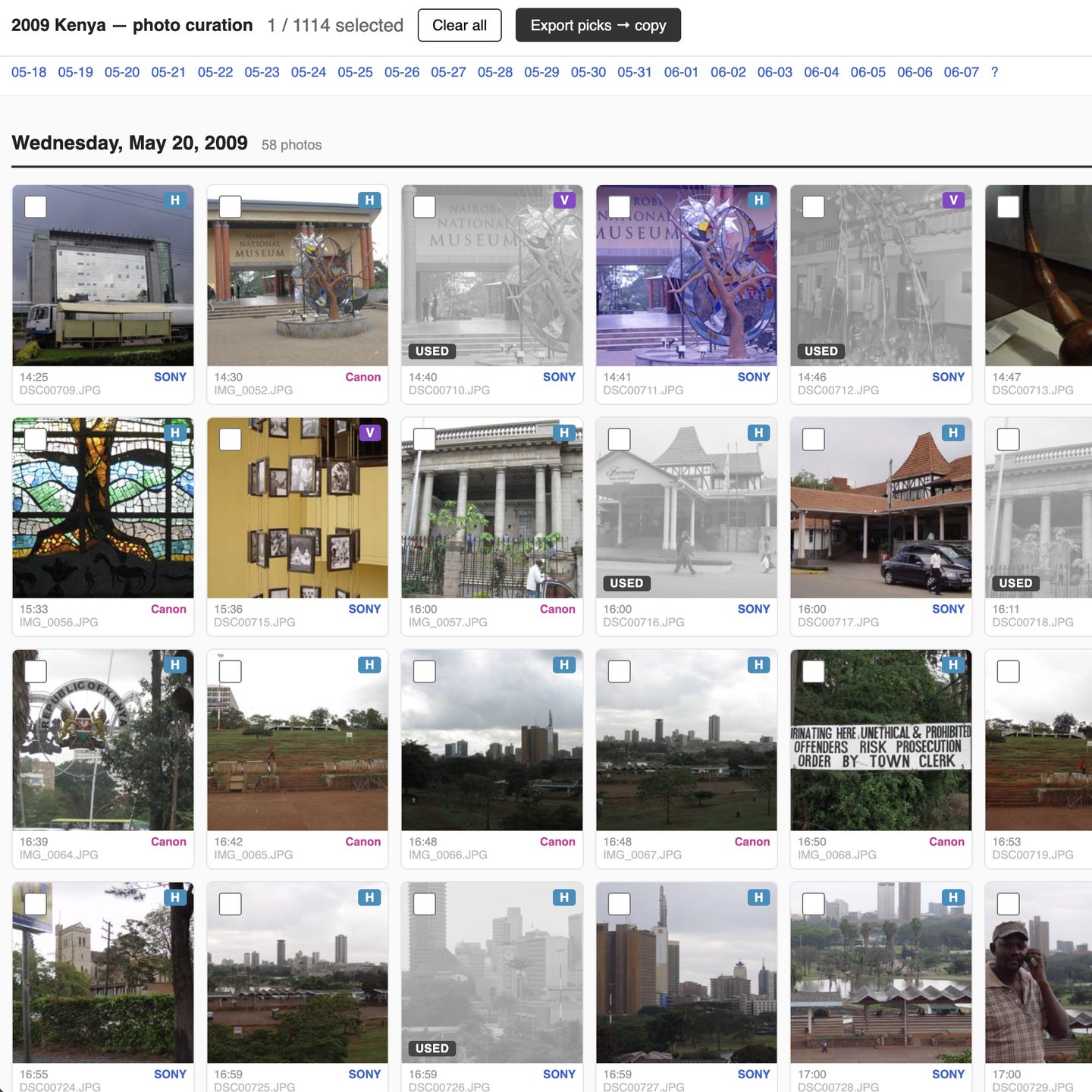
Then it built me a little web page on my own computer which had every thumbnail in true chronological order, tagged with which camera took it, whether it was vertical or horizontal, and whether I'd already used it. That page is the reason this was possible. Picking photos went from days of squinting at folders to something I could actually do. Out of the 1,114 that turned out to be unique, 100 made the final page.
Here's the part I think gets lost when people talk about AI, though. None of this was hands-off. I chose every one of those 100 photos. I decided whether the transcription was faithful to what I'd written, because I'm the only one who can confirm those pages are accurate. I called the layout. Claude resized and cropped and placed, and I looked at every section on my own machine before any of it went anywhere. Every correction I made to the page got mirrored back into the master document, so the two never drifted apart. It handled the tedious work, but the decisions were all mine.
And when it was all placed, it proofed the entire thing — 5,100 words. Spelling, inconsistent formatting, things I would've missed reading over and over.
Lastly, this journal lives on my website, and Claude and I rebuilt it from scratch, page by page. Whatever you're looking at right now, if you followed the link, is the same collaboration.
So across a few months, one tool served as assistant, transcriber, copy editor, developer, and web designer.
That's five jobs. Not one of them was thinking of something to say.